
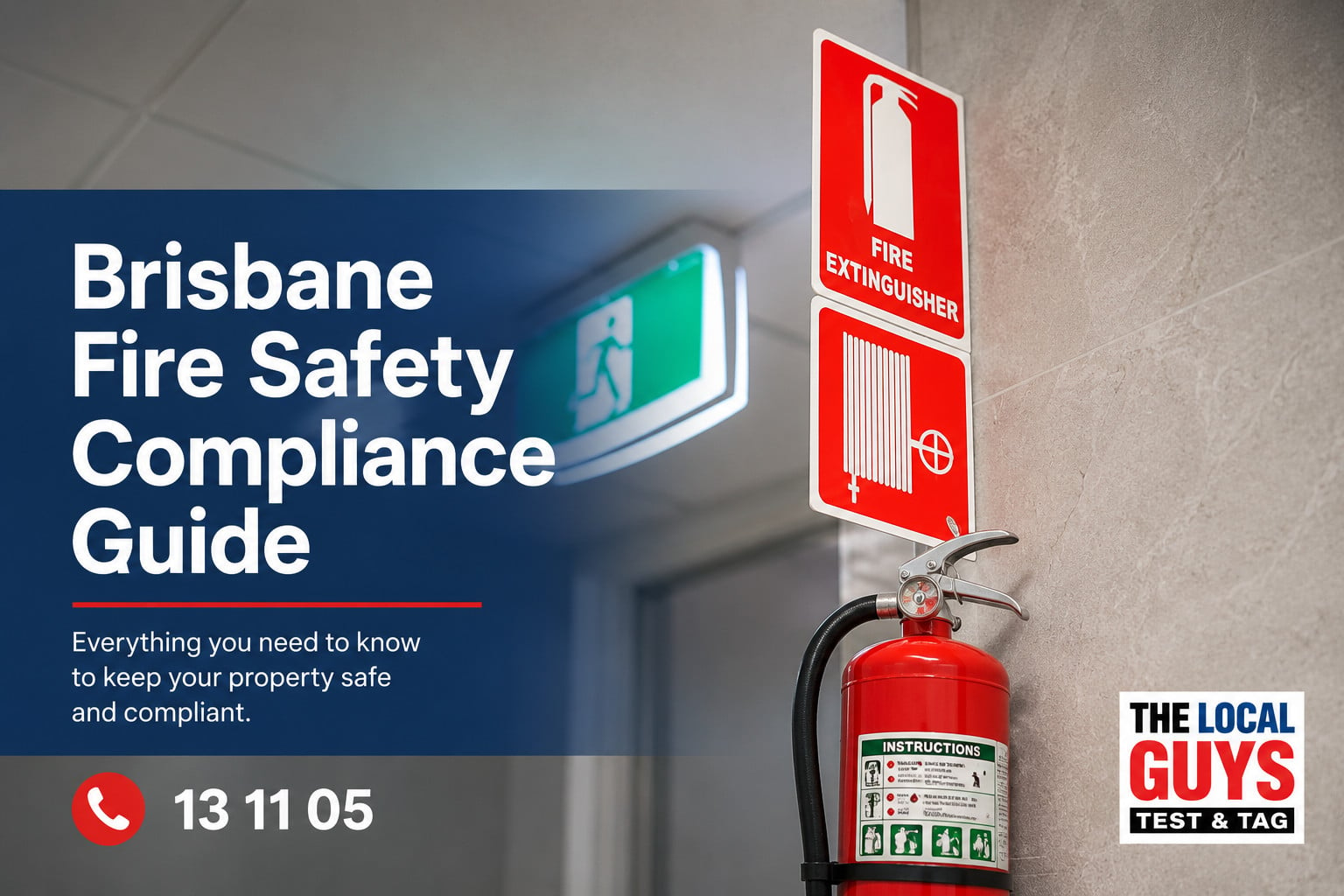
Running a business in Brisbane means keeping track of plenty of responsibilities, from looking after employees to making sure the workplace is safe for customers and visitors. Fire safety is one of those responsibilities that can easily slip down the priority list, particularly when nothing appears to be wrong.
You might have fire extinguishers mounted on the walls, illuminated exit signs above the doors and an emergency lighting system that was installed when the building opened. But having this equipment in place doesn't necessarily mean your business is meeting its ongoing maintenance obligations.
In Queensland, fire safety compliance involves more than installing the right equipment. Building owners and occupiers may also need to arrange regular inspections, maintain servicing records, address equipment defects and complete annual documentation.
One of the key requirements comes from Queensland Development Code (QDC) Mandatory Part 6.1, commonly referred to as QDC MP 6.1.
This guide explains what QDC MP 6.1 means for Brisbane businesses, which fire safety installations may require maintenance, how inspections work and what an annual occupier statement involves. We'll also explain how fire safety maintenance differs from electrical test and tag, so you can understand which requirements apply to your workplace.
What Is QDC MP 6.1 in Queensland?
QDC MP 6.1 stands for Queensland Development Code, Mandatory Part 6.1: Commissioning and Maintenance of Fire Safety Installations.
It establishes requirements for the commissioning and ongoing maintenance of prescribed fire safety installations in relevant Queensland buildings.
In straightforward terms, the code helps ensure that fire safety equipment remains capable of performing its intended function after installation.
For example, a fire extinguisher might have been correctly installed when a building first opened. However, over time, it could become damaged, lose pressure or be moved to an unsuitable location. Emergency lighting may also develop faults that aren't obvious during normal business operations.
QDC MP 6.1 provides a framework for maintaining these installations rather than assuming they're still operating correctly.
The code works alongside Queensland's building and fire safety legislation, including the Building Fire Safety Regulation 2008.
You can read the official requirements in the Queensland Development Code MP 6.1.
Why Does QDC MP 6.1 Matter for Brisbane Businesses?
For many businesses, fire safety maintenance isn't simply something that can be left until equipment stops working.
Prescribed fire safety installations must be maintained according to the applicable requirements, and businesses may need to demonstrate that maintenance has been completed.
This can involve arranging inspections by appropriately qualified people, maintaining service records and addressing identified defects.
The exact obligations depend on the building classification, installations present and the requirements that apply to the premises.
Queensland Government guidance confirms that QDC MP 6.1 establishes maintenance requirements for prescribed fire safety installations and applies to specified building classes.
Which Brisbane Buildings Must Comply With QDC MP 6.1?
QDC MP 6.1 applies to Class 1b and Class 2–9 buildings, including existing buildings.
These classifications cover a wide range of residential accommodation, commercial, industrial and public buildings.
For Brisbane businesses, this means the code may be relevant to offices, retail premises, warehouses, restaurants, hotels and other workplaces.
However, not every building has the same fire safety installations or maintenance requirements.
Building Classes Covered by QDC MP 6.1
| Building Class | Common Examples |
|---|---|
| Class 1b | Certain boarding houses, guest houses and small accommodation buildings |
| Class 2 | Apartment buildings |
| Class 3 | Hotels, larger boarding houses and certain residential accommodation |
| Class 4 | A dwelling within another building classification |
| Class 5 | Office buildings |
| Class 6 | Shops, restaurants and cafés |
| Class 7 | Car parks, storage buildings and warehouses |
| Class 8 | Factories, laboratories and certain production facilities |
| Class 9 | Healthcare, assembly and public buildings |
QDC MP 6.1 generally doesn't apply to Class 1a buildings, such as ordinary detached houses and townhouses, or Class 10 buildings, such as domestic garages and sheds.
That doesn't mean those buildings have no fire safety obligations. Different requirements may apply under other legislation.
For commercial premises, the first step is to establish the building classification and identify which prescribed fire safety installations are present.
What Are Prescribed Fire Safety Installations?
A prescribed fire safety installation is equipment or a building feature covered by Queensland's fire safety maintenance framework.
These installations are intended to support fire detection, warning, evacuation, firefighting or protection of building occupants.
The specific installations present depend on the building's design, use and applicable requirements.
For example, a small retail shop may have portable fire extinguishers and exit signs, while a larger commercial building may have fire detection systems, emergency lighting, fire hose reels and sprinkler systems.
Common Fire Safety Installations in Queensland Buildings
| Fire Safety Installation | General Purpose |
|---|---|
| Fire extinguishers | Provide a means of responding to suitable small fires |
| Fire hose reels | Provide firefighting water for trained or appropriate users |
| Fire hydrants | Support firefighting operations |
| Emergency lighting | Provide illumination when normal lighting fails |
| Exit signs | Help occupants identify escape routes |
| Fire detection and alarm systems | Detect fire conditions and warn occupants |
| Fire doors | Help limit the spread of fire and smoke |
| Sprinkler systems | Automatically respond to certain fire conditions |
| Smoke control systems | Help manage smoke movement within buildings |
| Emergency warning systems | Provide warnings or evacuation instructions |
Not every installation is required in every building.
The requirements depend on factors such as building classification, size, construction and relevant building approvals.
For businesses operating from leased premises, it's worth confirming which installations form part of the building's fire safety arrangements.
How Often Must Fire Safety Equipment Be Inspected in Queensland?
One of the most common questions businesses ask is how frequently their fire safety equipment needs servicing.
The answer depends on the type of equipment, the relevant maintenance standard and the requirements that apply to the building.
Some installations require six-monthly servicing, while others have annual or additional periodic maintenance requirements.
There is no single inspection interval that applies to every fire safety installation.
QDC MP 6.1 establishes the framework for determining the relevant maintenance requirements rather than requiring every item of fire safety equipment to be checked in exactly the same way.
Common Fire Safety Maintenance Standards
| Equipment | Relevant Standard or Framework | Maintenance Considerations |
|---|---|---|
| Portable fire extinguishers | AS 1851 and QDC MP 6.1 | Routine servicing and periodic maintenance |
| Fire hose reels | AS 1851 and QDC MP 6.1 | Inspection, testing and maintenance |
| Fire detection and alarm systems | Applicable AS 1851 requirements | Functional testing and maintenance |
| Emergency lighting | AS/NZS 2293.2 and applicable requirements | Periodic inspection and testing |
| Exit signs | AS/NZS 2293.2 and applicable requirements | Inspection and operational testing |
| Sprinkler systems | Applicable AS 1851 requirements | Scheduled inspection and maintenance |
| Fire doors | Applicable maintenance requirements | Inspection of condition and operation |
The applicable standard and edition should be confirmed for the particular installation and building.
Businesses should arrange maintenance with appropriately qualified professionals familiar with the relevant requirements.
Fire Extinguisher Maintenance Requirements in Queensland
Portable fire extinguishers are among the most recognisable pieces of fire safety equipment in a workplace.
They're commonly installed in offices, warehouses, workshops, retail premises and hospitality businesses.
However, simply having an extinguisher mounted on a wall doesn't confirm that it remains suitable for use.
Fire extinguishers need appropriate inspection and maintenance under the applicable fire safety requirements.
How Often Should Fire Extinguishers Be Serviced?
AS 1851 includes routine servicing schedules for portable fire extinguishers, including six-monthly, annual and more extensive periodic maintenance.
The exact checks depend on the extinguisher type and applicable service schedule.
For example, a technician may inspect the condition of the cylinder, safety pin, hose, nozzle, identification labels and relevant pressure indicators.
Additional servicing may be required depending on the extinguisher's age, condition and type.
Is Checking the Pressure Gauge Enough?
No. A pressure gauge can provide useful information about certain extinguisher types, but it doesn't confirm that every component is in suitable condition.
An extinguisher may have a normal pressure reading while still having a damaged hose, missing safety pin or other defect.
Some extinguishers also require different inspection methods because they don't have the same pressure indicator arrangement.
Scheduled servicing should therefore be completed by appropriately competent and authorised personnel.
What Happens if an Extinguisher Fails Inspection?
If an extinguisher is found to be defective, the technician should identify the problem and recommend the appropriate corrective action.
Depending on the issue, this may involve servicing, repair or replacement.
A faulty extinguisher shouldn't simply remain available for emergency use without the issue being addressed.
Businesses should also consider whether alternative fire protection arrangements are necessary while equipment is unavailable.
Emergency Lighting and Exit Sign Requirements in Brisbane
Emergency lighting helps people navigate a building when normal lighting fails.
Exit signs help occupants identify escape routes, particularly in unfamiliar buildings or during emergencies.
These systems are important in many commercial buildings, including offices, shopping centres, warehouses, hotels and other workplaces.
However, emergency lighting and exit signs can develop faults that aren't immediately obvious during normal operations.
What Does Emergency Lighting Testing Involve?
Depending on the system, testing may involve checking the operation of emergency luminaires, battery performance, switching arrangements and other components.
Relevant maintenance procedures are addressed through standards such as AS/NZS 2293.2 and applicable building requirements.
The exact testing schedule depends on the installation and requirements applying to the premises.
Why Are Exit Signs Important?
Exit signs need to remain visible and function as required.
If a sign is damaged, incorrectly positioned or not operating properly, it may affect how easily occupants can identify an escape route.
Businesses should ensure that exit signs and emergency lighting are included in their relevant maintenance arrangements.
If a defect is identified, it should be referred to an appropriately qualified service provider.
Fire Hose Reels, Hydrants and Sprinkler Systems
Larger commercial and industrial buildings may have additional firefighting systems such as hose reels, hydrants and sprinklers.
These installations can play an important role in managing fires and supporting emergency response.
However, they also require maintenance appropriate to their design and intended function.
Fire Hose Reels
Fire hose reels are designed to provide a controlled water supply for certain firefighting situations.
Maintenance may involve checking accessibility, equipment condition and relevant operating components.
The inspection and testing requirements depend on the installation and applicable standard.
Fire Hydrant Systems
Fire hydrants provide a water supply for firefighting operations.
They may require testing of relevant components, assessment of condition and other servicing procedures.
Businesses should ensure that maintenance is undertaken by appropriately qualified personnel.
Sprinkler Systems
Sprinkler systems are designed to respond automatically to certain fire conditions.
Because they involve multiple components, their maintenance requirements can be more extensive than those for portable equipment.
Inspections may cover control valves, water supplies, alarms and other relevant system elements.
The exact maintenance schedule depends on the system and applicable requirements.
What Is an Annual Occupier Statement in Queensland?
An annual occupier statement is an important part of Queensland's fire safety compliance framework.
It records information about the maintenance of prescribed fire safety installations in a building.
For relevant buildings, the occupier must prepare the statement in accordance with QDC MP 6.1 and the Building Fire Safety Regulation 2008.
The purpose is to document that the building's prescribed fire safety installations have been maintained in accordance with the applicable requirements.
Who Must Complete an Annual Occupier Statement?
The obligation generally rests with the building occupier.
If a tenant occupies a commercial building, the tenant may be responsible for ensuring the relevant maintenance obligations are met.
If the owner occupies the building, those responsibilities may fall on the owner.
However, contractual arrangements and the responsibilities of different parties should be reviewed carefully.
A business shouldn't assume that the landlord automatically handles every fire safety obligation simply because the premises are leased.
What Information Does an Occupier Statement Include?
The statement identifies the building and records relevant information about prescribed fire safety installations and their maintenance.
It may include:
- Building identification and address
- Occupier information
- Prescribed fire safety installations
- Relevant maintenance standards
- Required information about critical defects
- Details of relevant corrective action
- The required declaration
The official format is provided through Queensland's fire safety maintenance framework.
Where Is the Annual Occupier Statement Submitted?
Queensland Government guidance states that relevant building occupiers must provide a yearly occupier statement to the Commissioner of the Queensland Fire Department.
The Building Fire Safety Regulation also specifies requirements for preparing, submitting and retaining these statements.
Under the regulation, the occupier must generally provide the statement within 10 business days after it is required to be prepared and retain a copy with the relevant maintenance records for two years.
For the current submission requirements and official documentation, refer to the Queensland Government fire safety installations guidance.
Who Is Responsible for Fire Safety Compliance in Brisbane?
Fire safety compliance can involve building owners, tenants, business operators and property managers.
The exact responsibilities depend on the building, applicable legislation and occupancy arrangements.
For example, a shopping centre may have central fire protection systems managed through the building owner or management company, while individual tenants also have responsibilities for workplace safety.
A small business occupying an entire commercial premises may have a different arrangement.
Building Owners
Building owners may be responsible for certain fire safety installations, building features and maintenance arrangements.
They should understand the requirements applying to the building and any responsibilities assigned through occupancy arrangements.
Business Occupiers
Occupiers have specific obligations under Queensland's fire safety legislation.
These can include ensuring prescribed fire safety installations are maintained by appropriately qualified people, arranging inspections at the required intervals and maintaining appropriate records.
Property Managers
Property managers may coordinate maintenance, record keeping and communication between owners, tenants and service providers.
However, appointing a property manager doesn't automatically remove statutory obligations from the responsible parties.
Clear communication and documented maintenance arrangements can help avoid confusion about who is responsible for particular tasks.
How to Check Fire Protection Licensing in Queensland
Fire protection work in Queensland is regulated through the Queensland Building and Construction Commission (QBCC).
Different licence classes apply to different types of fire protection work.
A person qualified to inspect portable fire extinguishers may not automatically be authorised to maintain emergency lighting, sprinkler systems or fire alarm installations.
That's why businesses should verify that the provider holds the appropriate authorisation for the specific work being performed.
Common QBCC Fire Protection Licence Streams
| Licence Stream | General Area of Work |
|---|---|
| Portable fire protection | Portable firefighting equipment |
| Electrical fire protection | Relevant fire alarms and emergency lighting |
| Water-based fire protection | Sprinklers, hydrants and associated systems |
| Passive fire protection | Relevant fire doors, walls and other passive protection systems |
| Special hazard fire systems | Specialised fire suppression installations |
The precise scope depends on the licence class held.
Queensland's licensing framework distinguishes between inspection, installation, maintenance and certification activities. A licence covering one activity doesn't necessarily authorise every other type of work.
How Can Businesses Verify a Fire Protection Provider?
Before arranging maintenance, ask which licence class applies to the work and request the relevant licence details.
You can review the available licence classes and requirements through the QBCC fire protection licensing information.
If your premises contain multiple types of fire safety installations, you may need more than one appropriately licensed professional to complete the required maintenance.
What Fire Safety Maintenance Records Should Businesses Keep?
Maintaining fire safety equipment is important, but so is keeping accurate documentation.
If a problem occurs or a compliance inspection takes place, the business may need to demonstrate that relevant maintenance activities have been completed.
Service tags alone may not provide all the information required.
Depending on the installation, records may include inspection results, identified defects, corrective actions and maintenance dates.
Fire Safety Maintenance Records Checklist
| Record | Purpose |
|---|---|
| Equipment register | Identifies prescribed fire safety installations |
| Inspection dates | Shows when maintenance was performed |
| Service reports | Documents relevant maintenance activities |
| Defect reports | Identifies equipment requiring attention |
| Corrective action records | Records repairs and remedial work |
| Annual occupier statements | Documents relevant annual maintenance declarations |
| Contractor details | Identifies the service provider and relevant qualifications |
| Maintenance schedule | Helps plan future inspections |
Queensland's Building Fire Safety Regulation includes requirements about the content and retention of maintenance records.
Businesses should ensure their record-keeping processes reflect the applicable legislative requirements rather than relying on a generic spreadsheet alone.
What Happens if Fire Safety Equipment Has a Critical Defect?
A critical defect is more serious than a routine maintenance issue.
It generally involves a problem likely to make a prescribed fire safety installation inoperable and significantly affect occupant safety during a fire or relevant emergency.
For example, a major fault affecting a fire detection system could create a different level of risk from a minor issue involving one component.
Queensland's Building Fire Safety Regulation includes specific notification requirements for critical defects.
A person undertaking maintenance who identifies a critical defect must provide the required notice to the building occupier within the specified timeframe.
The occupier must then address the situation in accordance with the applicable requirements.
Why Should Businesses Act Quickly?
Leaving a serious fire safety defect unresolved can increase risks to occupants and create compliance problems.
If a critical defect is identified, the responsible person should seek guidance from an appropriately qualified fire protection professional and take the required corrective action.
The issue should also be properly documented.
For major defects, businesses may need to consider additional safety measures while repairs are being arranged.
What Is the Difference Between QDC MP 6.1 and AS/NZS 3760?
This distinction is particularly important for Brisbane businesses because fire safety maintenance and electrical test and tag are separate activities.
Both support workplace safety, but they deal with different equipment and requirements.
QDC MP 6.1 addresses the commissioning and maintenance of prescribed fire safety installations in relevant Queensland buildings.
AS/NZS 3760:2022 provides requirements for in-service safety inspection and testing of applicable electrical equipment and residual current devices.
Testing portable electrical appliances doesn't automatically satisfy a building's fire safety maintenance obligations.
Similarly, completing a fire extinguisher inspection doesn't mean the workplace's electrical equipment has been tested.
Fire Safety Compliance vs Electrical Test and Tag
| Requirement | Fire Safety Maintenance | Electrical Test and Tag |
|---|---|---|
| Main purpose | Maintain relevant fire safety installations | Assess applicable electrical equipment safety |
| Relevant framework | QDC MP 6.1 and applicable standards | AS/NZS 3760 and applicable electrical safety obligations |
| Typical equipment | Fire extinguishers, exit signs, emergency lighting and fire systems | Portable electrical appliances, leads and applicable RCDs |
| Maintenance frequency | Depends on the installation and relevant standard | Depends on equipment type, environment and applicable requirements |
| Responsible personnel | Appropriately qualified and authorised fire protection personnel | Competent electrical testing personnel, with licensing where required |
| Documentation | Fire safety maintenance records and applicable statements | Electrical testing records and reports |
Does Electrical Test and Tag Make a Brisbane Business Fire Compliant?
No. Electrical test and tag addresses a different part of workplace safety.
For example, a business might have its electrical appliances tested in accordance with the relevant requirements but still have overdue fire extinguisher inspections.
Alternatively, a building's fire safety installations may be maintained correctly while portable electrical equipment remains overdue for testing.
Businesses should understand both sets of obligations and arrange the appropriate services.
The Local Guys provides professional test and tag services in Brisbane, helping businesses manage applicable electrical equipment testing requirements.
For fire safety maintenance, businesses should engage appropriately qualified and licensed fire protection providers.
Common Fire Safety Compliance Mistakes Brisbane Businesses Should Avoid
Fire safety problems don't always result from businesses deliberately ignoring their responsibilities.
Sometimes the issue is simply a lack of clarity about which equipment requires maintenance or who should arrange it.
For example, a business may assume that annual electrical testing also covers its fire protection equipment.
Another business may rely on a building manager without confirming whether the required maintenance has actually been completed.
Assuming Equipment Is Compliant Because It Looks Fine
An extinguisher or exit sign may appear to be in good condition while still requiring maintenance.
Visual appearance alone doesn't establish compliance.
The relevant inspections and maintenance procedures must be completed according to the applicable requirements.
Missing Inspection Dates
Businesses sometimes lose track of servicing dates when they have multiple pieces of equipment or operate from several premises.
Maintaining an equipment register and service schedule can make it easier to identify upcoming inspections.
Not Addressing Identified Defects
Completing an inspection isn't enough if identified defects remain unresolved.
Businesses should track corrective actions and ensure relevant repairs are completed within the required timeframe.
Using a Provider Without the Appropriate Licence
Different fire protection activities can require different qualifications and licence classes.
Before arranging maintenance, verify that the provider is authorised for the work being performed.
Forgetting the Annual Occupier Statement
Businesses may complete their routine maintenance but overlook the annual documentation required under Queensland's fire safety framework.
The annual occupier statement should be included in the business's compliance calendar where applicable.
Frequently Asked Questions About QDC MP 6.1 and Brisbane Fire Safety
What Is QDC MP 6.1 in Queensland?
QDC MP 6.1 is part of the Queensland Development Code and establishes requirements for commissioning and maintaining prescribed fire safety installations in relevant buildings. It works alongside Queensland's building and fire safety legislation.
Does QDC MP 6.1 Apply to Every Building in Brisbane?
No. QDC MP 6.1 applies to Class 1b and Class 2–9 buildings, including existing buildings. It generally doesn't apply to Class 1a detached houses and townhouses or Class 10 domestic structures. Other fire safety requirements may still apply to those buildings.
How Often Must Fire Extinguishers Be Inspected in Queensland?
Portable fire extinguishers are subject to relevant maintenance requirements, including routine six-monthly servicing under applicable AS 1851 schedules. Additional annual and periodic maintenance may also be required depending on the extinguisher type and relevant standard.
What Is an Annual Occupier Statement?
An annual occupier statement records information about the maintenance of prescribed fire safety installations in a relevant Queensland building. The occupier must prepare and submit it according to the requirements of QDC MP 6.1 and the Building Fire Safety Regulation 2008.
Who Is Responsible for Fire Safety Maintenance in a Rented Commercial Building?
Responsibilities depend on the building, occupancy arrangements and applicable legislation. Queensland's fire safety framework places specific obligations on building occupiers, although owners and other parties may also have responsibilities. Businesses should clarify their obligations rather than assuming the landlord handles everything.
Does Emergency Lighting Need Regular Testing?
Yes. Emergency lighting in relevant buildings is subject to applicable inspection and maintenance requirements. The testing procedures and intervals depend on the installation and relevant standards, including AS/NZS 2293.2 where applicable.
Do Fire Protection Contractors Need a QBCC Licence?
Many types of regulated fire protection work in Queensland require the appropriate QBCC licence. Different licence classes apply to portable equipment, emergency lighting, water-based systems and other fire protection activities. Businesses should verify the specific authorisation required for the work.
What Happens if Fire Safety Equipment Fails an Inspection?
The maintenance provider should document the defect and recommend appropriate corrective action. Some problems may require repair or replacement, while critical defects can trigger additional notification and safety requirements. The responsible party should arrange the necessary action promptly.
Is AS 1851 the Same as AS/NZS 3760?
No. AS 1851 addresses routine servicing of fire protection systems and equipment, while AS/NZS 3760 covers in-service safety inspection and testing of applicable electrical equipment and RCDs. They address different workplace safety requirements.
Can Electrical Test and Tag Replace Fire Extinguisher Testing?
No. Electrical test and tag doesn't replace required fire extinguisher maintenance. Businesses must arrange each service according to the requirements applying to their equipment and premises.
Keeping Your Brisbane Business Compliant With Fire Safety Requirements
Fire safety compliance isn't something businesses should think about only when an inspection is approaching or equipment develops an obvious fault.
Fire extinguishers, emergency lighting, exit signs and other prescribed fire safety installations need appropriate maintenance to help ensure they're ready when required.
For Brisbane businesses, understanding QDC MP 6.1 is an important part of managing these responsibilities. That includes identifying the installations in the building, arranging maintenance by appropriately qualified people, addressing defects and keeping the necessary records.
It's also important to distinguish fire safety maintenance from other workplace safety activities.
Electrical test and tag helps businesses manage risks associated with applicable electrical equipment, but it doesn't replace fire protection maintenance obligations.
If your business needs electrical equipment testing, The Local Guys Test & Tag provides electrical test and tag services in Brisbane.
Our team can help you understand the electrical testing services available for your workplace.
Request a Free Test and Tag Quote
Call 13 11 05
For inspections or maintenance of prescribed fire safety installations, contact an appropriately licensed Queensland fire protection provider.

