
Most business owners don't skip test and tag because they don't care about safety. They skip it because it slips through the cracks. There's always something more urgent, another bill to pay, another task on the list. And because nothing has gone wrong yet, it's easy to assume nothing will.
That thinking is exactly what makes electrical incidents so devastating when they happen.
This post covers what is actually at stake when test and tag gets delayed, ignored, or forgotten entirely. Not in a fear-mongering way. Just the honest reality of what Australian work health and safety law requires, what insurers expect, and what happens to business owners when something goes wrong and the paperwork isn't in order.
First, a Quick Refresher on What Test and Tag Actually Is
Electrical test and tag is the process of inspecting and electronically testing portable electrical appliances in your workplace to confirm they are safe to use. Every item that plugs into a standard power outlet falls under this. Extension cords, laptop chargers, kettles, drills, fridges, printers. If it has a plug, it needs to be tested.
The process follows the Australian Standard AS/NZS 3760:2022, which sets out who can perform the testing, how it needs to be done, and how often it needs to happen depending on your industry and environment.
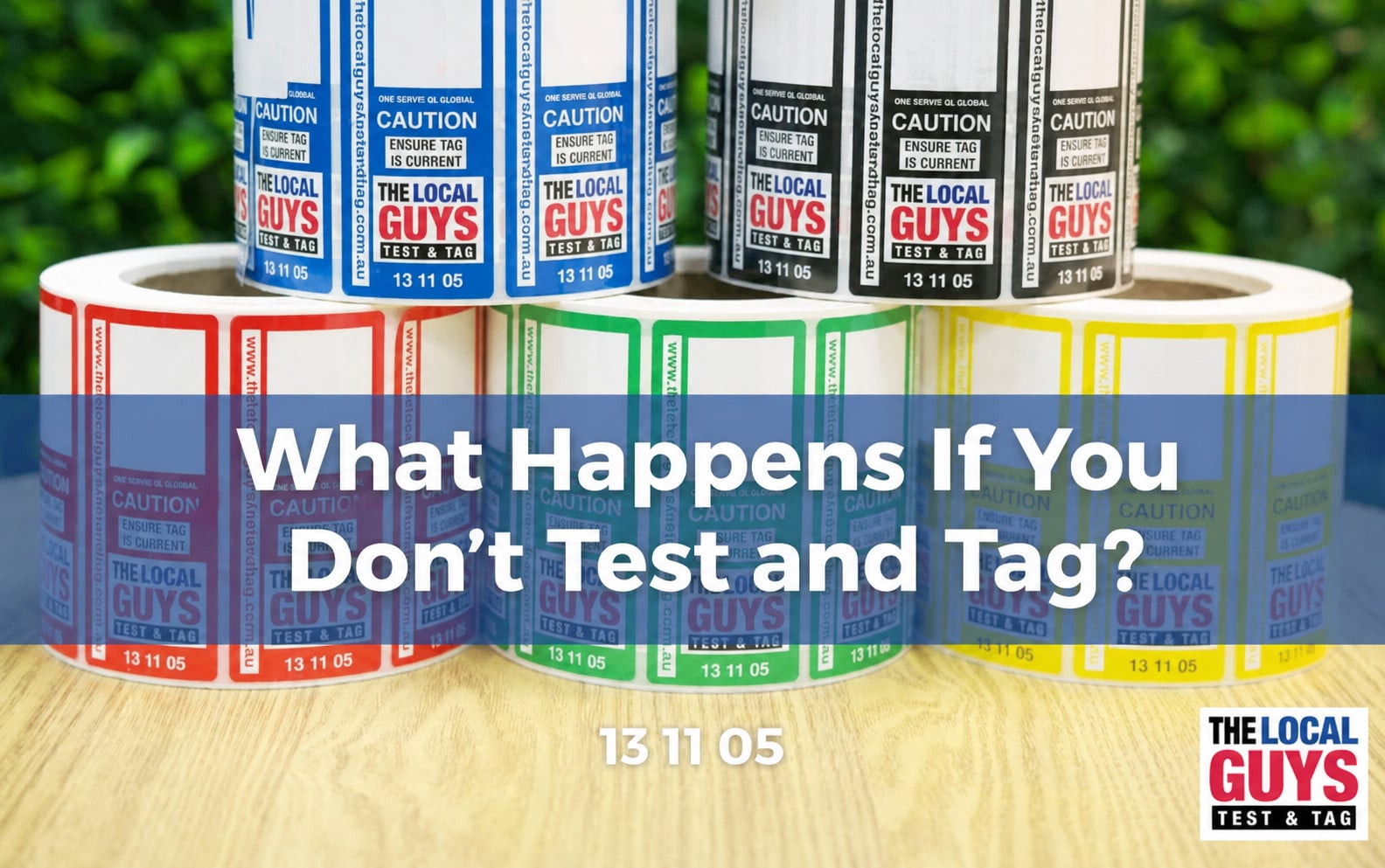
A qualified technician visually inspects each item, runs it through a portable appliance tester (PAT), and attaches a tag showing the test date, due date, and the technician's licence number. You receive a full report and certificate of compliance. That's the paper trail that protects you if anything is ever questioned later.
The Honest Answer: What Actually Happens If You Don't Test and Tag?
1. You Are Likely in Breach of WHS Law
Work health and safety legislation in Australia places a legal duty of care on employers and persons conducting a business or undertaking (PCBUs) to ensure, so far as is reasonably practicable, that the workplace is safe. That includes the electrical equipment your team uses every day.
Regular portable appliance testing is one of the most widely accepted ways to demonstrate that you are taking electrical safety seriously and meeting your obligations under the relevant WHS Acts. Each state and territory has its own version of the legislation, but the duty of care principle is consistent across all of them. Whether you run a small office in Adelaide or manage multiple sites across Sydney and Melbourne, the obligation is the same.
Not having a current test and tag record does not automatically mean you will be fined on the spot. But if a WHS inspector visits your premises and your equipment is overdue, or if an incident occurs and there is no compliance record, you are in a far weaker position than you need to be.
2. Fines Can Be Significant
Safe Work Australia and the relevant state bodies have the authority to issue infringement notices and pursue prosecutions when WHS duties are breached. Fines under WHS legislation vary by state, but penalties for serious breaches can reach into the hundreds of thousands of dollars for businesses and higher again for repeat or negligent offences. This applies whether you are operating in Brisbane, Perth, or anywhere else in the country. Safe Work regulators in every state are active, and electrical safety is consistently on their radar.
The fines for an electrical safety inspection failure or untested equipment are not always the starting point, but they become very real the moment an inspector finds non-compliance or an incident is investigated. At that point, having no test records is not a grey area. It is documentation that the risk was not managed.
3. Your Insurance May Not Cover You
This is the one that surprises most business owners.
Many public liability and business insurance policies contain clauses that require the business to maintain a safe working environment and comply with relevant Australian Standards. If an electrical fault causes injury, fire, or property damage and your test and tag was out of date or never done, your insurer may use that as grounds to reduce or deny a claim.
Read your policy. Some are explicit about it, others are not. But the principle is the same across most commercial policies: if you failed to take reasonable steps to prevent a foreseeable risk, your coverage is at risk.
4. An Employee or Visitor Gets Hurt
Let's not gloss over the most serious outcome.
Faulty electrical equipment causes fires, electric shocks, and in the worst cases, death. These are not theoretical risks. Electrical incidents in Australian workplaces happen every year, and in many cases the equipment involved had not been regularly tested.
When someone is hurt on your premises by faulty equipment, the investigation will look at what steps you took to manage the risk. Was the equipment tested? Were records kept? Was it done by a qualified person? If the answer to those questions is no, the liability exposure for the business and potentially the individual owner or manager is substantial.
Beyond the legal and financial consequences, there is the human cost. An injury to a staff member or customer because of something that was preventable is not something that is easily moved on from.
5. You Lose the Paper Trail That Protects You
Even if nothing ever goes wrong, the compliance record from regular test and tag serves a purpose well beyond passing an inspection.
It acts as an asset register of your electrical equipment. It documents due dates so you know when testing is next required. It shows auditors, clients, or head office that you take workplace safety seriously. For businesses operating in sectors like aged care, education, healthcare, or government contracting, that documentation is often a prerequisite to being awarded work in the first place.
National clients and multi-site businesses deal with this constantly. The organisations they work with require current compliance records before anyone sets foot on site. Without them, the work simply does not happen.
What About New Equipment? Does That Need to Be Tested Too?
A common misconception is that brand new equipment is automatically safe and does not need a tag. Technically, a new item does not need to be tested before first use, but it does require a "new to service" tag showing the date it was first brought into use. That tag is valid for the first testing cycle, and after that the item needs to go through the standard portable appliance testing process.
The reason new items still need a tag at all is straightforward. Faulty new equipment exists. Recalls happen. A brand new kettle with a wiring defect is still a risk. The tag is your record that you acknowledged when the item entered service and when it needs to be reviewed.
What About Other Safety Equipment in the Workplace?
Test and tag for electrical appliances is the piece most business owners are familiar with, but workplace electrical safety covers more than portable equipment. A fully compliant workplace also keeps on top of:
Safety switches (RCD testing): Residual current devices are designed to trip and cut power if they detect a dangerous electrical fault. They only protect you if they are working. RCDs require push-button testing every six months and timed testing annually. Many workplaces have them but have never formally tested them.
Fire extinguishers: An extinguisher that has not been tested and maintained may not work in a fire. Testing confirms the pressure, integrity, and condition of every unit and is a requirement under Australian fire safety standards.
Emergency exit lights: Exit lighting needs to function during a power failure. Testing confirms that the battery backup and illumination are working as required under AS/NZS 2293.2:2019.
Fire blankets: Like extinguishers, fire blankets need regular inspection to confirm they are in good condition and ready to use.
Microwave leakage testing: Commercial microwaves can develop leaks over time. Testing confirms radiation emissions are within the safe limits set by Australian standards.
A workplace that ticks all of these boxes is one where the employer has genuinely discharged their duty of care. One that only does some of them, or none of them, is one where the gaps become a liability the moment anything is questioned.
How Often Does Testing Need to Happen?
The frequency depends on your environment:
Construction, demolition, and mining: every three months
Workshop and manufacturing environments: every six months
Offices and low-risk environments: every 12 months to five years, depending on the specific context and equipment
If you are unsure where your business sits, a qualified technician can advise you based on your industry, the type of equipment you use, and the physical environment it is used in.
So Where Does This Leave You?
If your test and tag is overdue, the fix is simple. Book a qualified technician, get the equipment tested, get your certificate of compliance, and set a reminder for next time. The service itself is straightforward, mobile, and takes place at your premises with minimal interruption to your day.
What is not simple is recovering from an incident, a fine, or a denied insurance claim because the paperwork was not in order. The cost and stress of those situations are orders of magnitude greater than the cost of staying current.
The Local Guys Test and Tag team operates across every state and territory in Australia, with technicians on the ground in Sydney, Melbourne, Brisbane, Perth, Adelaide, Gold Coast, Canberra, Hobart and beyond. We work around your schedule and provide a full report and certificate of compliance on every job. If you have questions about what your workplace needs or how often your equipment should be tested, you can call 13 11 05 any time. Real people, 24 hours a day.

