
It's late. You've just finished a long day and you're sitting there wondering whether your business is actually compliant with all this electrical safety stuff. You've heard the words "test and tag" before. Maybe a technician mentioned it. Maybe another business owner brought it up. Maybe you got a quote once and never followed through.
Either way, you're here now, and the honest answer is: it's not as complicated as it sounds. Here's everything a small business owner actually needs to know, without the legal language and without the overwhelm.
What Is Test and Tag, in Plain English?
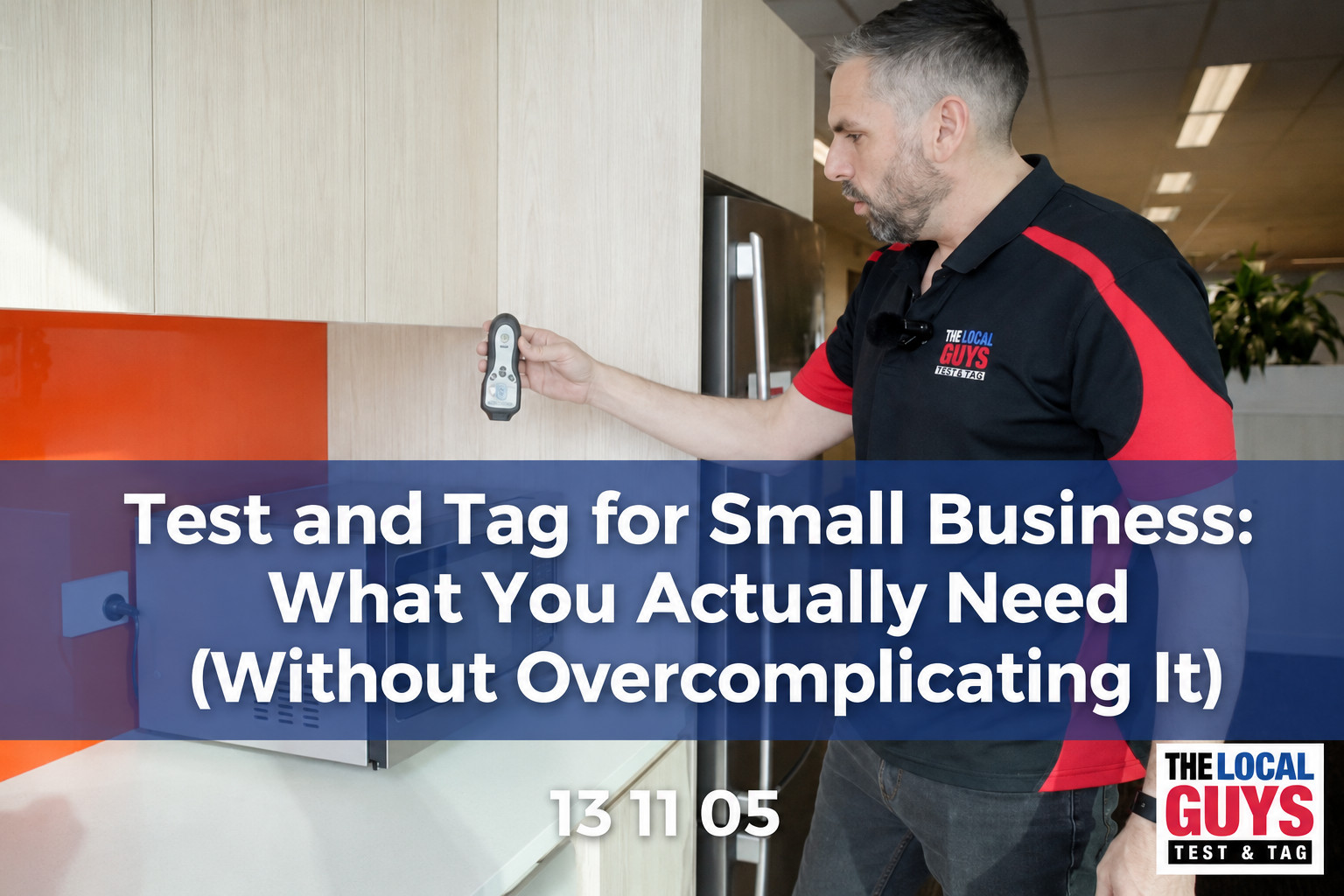
Test and tag is the process of checking the electrical appliances in your workplace to make sure they are safe to use. A qualified technician comes to your business, visually inspects every item that plugs into a power outlet, runs it through a testing device, and attaches a small label showing when it was tested and when it needs to be tested again.
That is genuinely it. You do not need to do anything yourself. You do not need to understand how the testing works. You just need to book it and let the technician do their job.
At the end, you receive a report listing every item tested and a certificate of compliance. Those two documents are what protect you if anything is ever questioned by a WHS inspector or an insurer.
Do I Actually Have to Do This?
Yes, if you have staff or run premises where people work.
Under Australian work health and safety law, employers have a duty of care to maintain a safe workplace. That includes the electrical equipment your team uses. Regular portable appliance testing is one of the accepted ways to demonstrate you are meeting that obligation.
It is not technically a law that says "you must get test and tag done by this date." But if an incident happens and there is no compliance record, or if a WHS inspector visits and your equipment has never been tested, you are in a difficult position. The fine risk and liability exposure in that situation is real, and it is far more expensive than the cost of just getting it done.
Think of it like having a fire extinguisher. Nobody is checking your extinguisher every Tuesday. But the moment something goes wrong and there is no extinguisher, or the extinguisher has not been maintained, the question of why becomes a very serious one.
What Equipment Do I Need to Get Tested?
Anything that plugs into a standard power outlet. If it has a cord and a plug, it needs a tag.
For most small businesses, the list looks something like this: computers and monitors, phone chargers, laptop chargers, printers, extension cords, power boards, the kettle in the kitchen, the microwave in the break room, desk lamps, fans, portable heaters, and any tools or equipment specific to what you do.
One thing that catches a lot of small business owners off guard: personal items brought in by staff also need to be tested. If someone plugs their own laptop charger or a personal fan into a power outlet at your premises, that item falls under your duty of care as the employer. It needs a tag too.
The technician will walk through your premises and assess everything. You do not need to prepare a list in advance, though it helps to think about any storage areas or rooms that might get missed.
How Often Does It Need to Happen?
This depends on what your business does and the environment your equipment is used in.
For most small offices, cafes, retail shops, and similar environments, testing needs to happen once a year. That is the standard interval for low to medium risk workplaces under the Australian Standard AS/NZS 3760:2022.
If your business involves construction, trades, or manufacturing, the intervals are shorter. Construction sites require testing every three months. Workshop and manufacturing environments require testing every six months. This is because the equipment is used harder and in tougher conditions.
If you are not sure where your business sits, just ask when you book. A qualified technician will tell you exactly what applies to your situation.
What About New Equipment I Just Bought?
New equipment does not need to be tested before you start using it. Manufacturers are expected to sell products that are safe.
What it does need is a "new to service" tag, which is a label showing the date the item was first brought into use. This tag stays valid until either 12 months pass or your next round of testing comes up, whichever is sooner.
You can apply this tag yourself. They are available from electrical suppliers. If you are not sure about it, the technician who does your next round of testing can handle it as part of the job.
Is There Other Safety Testing My Business Needs?
Test and tag for electrical appliances is the most common service, but a fully compliant workplace usually involves a few other things depending on what equipment you have.
Safety switches: If your premises has residual current devices (the safety switches in your switchboard), those need to be tested separately. RCD testing confirms that your safety switches will actually trip in a fault. Many businesses have them but have never had them formally tested.
Fire extinguishers: If you have fire extinguishers on site, they need regular inspection and testing to confirm they are in working order. An extinguisher that has not been maintained may not work when you need it.
Emergency exit lights: If your premises has emergency exit lighting, those require testing to confirm the battery backup functions during a power failure. This is often overlooked by smaller businesses that have one or two exit lights and assume they are fine.
The microwave in your kitchen: If you have a commercial or older microwave on site, microwave leakage testing confirms it is not emitting radiation above safe levels. Most business owners have never heard of this one. It is a simple test and worth doing.
You do not need to figure out which of these applies to you right now. When you book a test and tag service, the technician can assess your premises and let you know what else is relevant.
What Does It Actually Cost?
For most small businesses, the cost is straightforward. The minimum charge covers up to 32 items and includes the testing, all tags, the full report, and the certificate of compliance.
If you have more than 32 items, the cost increases at a per-item rate. The technician will give you a quote before starting.
For a typical small office, cafe, or retail shop, a single annual test and tag visit is one of the cheaper compliance costs your business will have. Far cheaper than a WHS fine. Far cheaper than an insurance claim that gets rejected because there were no compliance records.
How Does the Process Work?
You book a time that suits you. The technician comes to your premises, usually outside business hours if you prefer to avoid disruption. They walk through the space, test everything that needs testing, attach the tags, and hand you a report and certificate before they leave.
The whole thing for a small business usually takes under an hour. You do not need to be heavily involved. You just need to be there to let them in and point them toward any areas they might miss.
After the visit, most providers send you a reminder when your next testing date is coming up so you do not have to track it yourself.
One Last Thing
If you have read this far and your main takeaway is "I probably should have done this already" — that is fine. Most small business owners are in the same position. It is one of those things that is easy to put off because nothing has gone wrong yet.
The good news is that getting started is genuinely simple. You do not need to know anything about electrical safety standards, testing intervals, or compliance requirements. That is what the technician is for.
The Local Guys Test and Tag team services small businesses across Sydney, Melbourne, Brisbane, Perth, Adelaide, Canberra, Hobart, Gold Coast and everywhere in between. Call 13 11 05, tell us where you are and roughly how many items you have, and we will handle the rest.

