
Is Test and Tag mandatory? With so many WHS Regulations and safety standards to consider, it can be tricky to know exactly what’s required. If you're a business owner or property manager in Australia, you've probably asked yourself this question.
Testing and tagging isn’t mandatory for every workplace, but under the Australian Standard AS/NZS 3760:2022, employers have a clear duty of care to protect staff and visitors from electrical hazards. Regular inspection and testing of electrical appliances is one of the easiest ways to stay compliant, prevent fire and electric shock risks, and keep your workplace running safely.
At The Local Guys, we help businesses across Australia stay compliant with professional inspection and testing of electrical appliances. Whether you’re managing an office, a workshop, or a construction site, our qualified technicians provide electrical safety testing, clear compliance reports, and friendly reminders so you never miss your next inspection interval.
What is Test and Tag and Why Is It Important?
Test and Tag is the process of inspecting and electrically testing portable appliances to make sure they’re safe to use.
It involves 2 key steps:
- Visual inspection: checking electrical cords, plugs, power boards, and other equipment for visible signs of wear or damage.
- Electrical testing: using a portable appliance tester (PAT tester) to run checks such as insulation resistance, polarity check, and earth continuity test.
If the item passes, it receives a durable test tag showing the last date of testing, the technician's details, the retest date, and other relevant information. If the item fails, it must be labelled with a danger tag and removed from service immediately.
Testing and tagging is the most effective ways to reduce fire and electrical hazards in the workplace. From faulty electrical equipment to damaged extension leads, most risks can be identified early through regular electrical safety checks, helping you avoid downtime, fines, and serious accidents.
Is Test and Tag a Legal Requirement in Australia?
Yes, in some industries Test and Tag is compulsory, and in others, it’s strongly recommended.
- In construction, demolition, and mining, Test and Tag is a legal requirement. Equipment must be tested every 3 months, and items must follow the RGBY rotation of quarterly tag colours (Red, Green, Blue, Yellow) to prove compliance.
- In other industries such as offices, retail, schools, and hospitality, testing and tagging isn’t mandated by legislation, but under WHS Regulations, business owners and managers still carry the legal responsibility to test electrical equipment regularly and provide a safe environment.
Failing to meet Australian safety standards can lead to heavy fines, liability if an accident occurs, or rejected insurance claims. That’s why most businesses treat Test and Tag as compulsory, even when the law doesn’t explicitly say so. Regular inspection and testing shows you’ve taken reasonable steps to prevent electrical hazards, helping protect staff, customers, and your reputation.
Why Many Businesses Treat Test and Tag as Compulsory
Even in industries where Test and Tag isn’t legally mandated, there are strong reasons to follow a routine testing schedule:
- Insurance requirements: many insurers expect evidence of regular electrical safety testing to validate claims.
- Liability protection: if an electric shock, fire, or accident occurs due to faulty electrical equipment, you could be held responsible without documented compliance.
- Workplace safety: regular testing reduces the risk of electrical hazards, protecting staff, contractors, and visitors.
- Professional reputation: compliance certificates and clear test tags show customers and auditors that safety is a priority.
Choosing proactive electrical safety testing is the simplest way to prove you’ve taken reasonable steps to protect your business.
In fact, many insurance providers will not honour claims if faulty or untested electrical equipment is involved in an accident. Without documented inspection and testing, a workplace fire, electric shock, or equipment failure could leave you personally liable.
How Often Is Test and Tag Required?
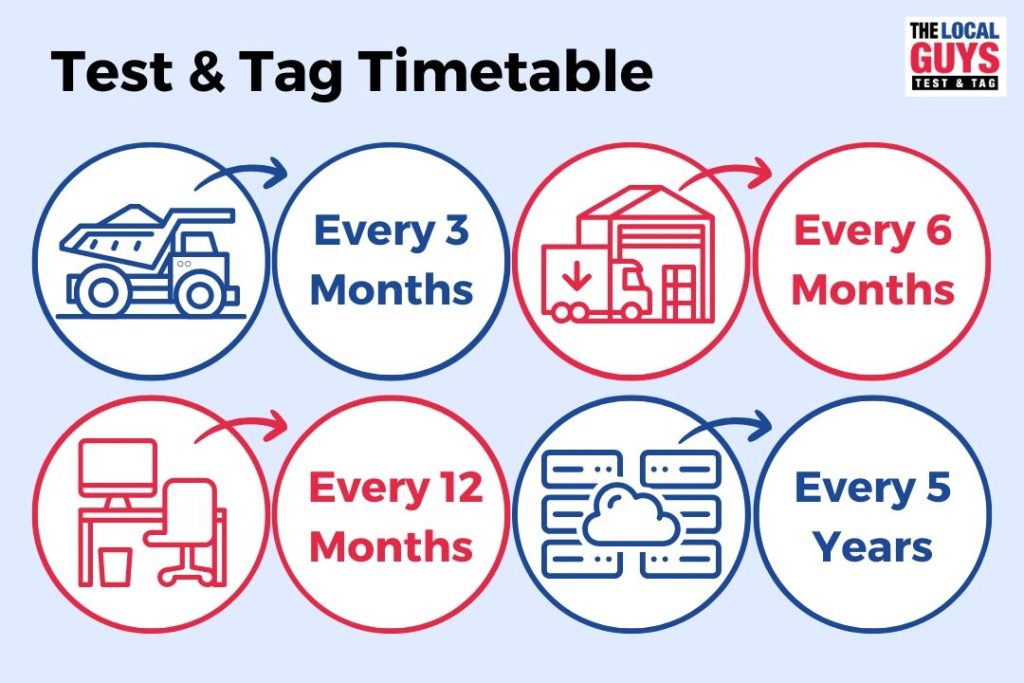
Testing intervals depend on the work environment and how often electrical appliances are used:
| Environment | Risk Level | Testing Interval | Examples |
|---|---|---|---|
| Construction and Demolition Sites | High risk | Every 3 months | Power tools, extension leads, power boards, portable electrical appliances |
| Workshops & Factories | Moderate risk | Every 6 months | Heavy-use machinery, power tools, cord-connected equipment |
| Offices, Retail Stores & Schools | Low risk | Every 12 months | Computers, monitors, kitchen appliances |
| Server Rooms | Very low risk | Every 5 years | Networking equipment, servers |
In addition to portable electrical appliances, there are specific requirements for:
- RCD safety switches (Residual Current Devices): push-button tests every 6 months, full operating time tests every 12 months with an RCD tester under AS/NZS 3760:2022
- Microwaves: Microwave Leakage Testing is recommended every 12 months under AS/NZS 60335.2.25:2020, with 6-monthly testing advised for hostile environments.
- Fire extinguishers & fire blankets: every 6 months for general service, every 5 years for hydrostatic pressure testing under AS1851:2012 - Routine service of fire protection systems and equipment.
- Emergency exit lights: function test every 6 months, full backup duration test every 12 months under AS/NZS 2293.2:2019.
These inspection intervals are set out in AS/NZS 3760:2022 and supported by WHS Regulations.
Who Can Carry Out Test and Tag?
Test and Tag can only be performed by a competent person, as defined under AS/NZS 3760:2022. This means:
- They must have completed recognised training in electrical safety testing.
- They must understand how to use a portable appliance tester (PAT tester).
- They must be able to conduct a visual inspection, polarity check, and earth continuity test correctly.
A licensed electrician isn’t always required, but the tester must be trained and qualified. At The Local Guys, every service is carried out by a fully licensed technician who provides:
- A detailed compliance report covering all tested equipment.
- Test tags with tester details and the retest date clearly marked.
- Options to bundle in other services such as fire safety, RCD testing, and emergency exit light inspections.
- Upfront Test and Tag prices, and a free, no-obligation quote within 2 business hours.
- $20,000,000 in Public Liability Insurance.
- Peace of mind with a current Police Clearance and a Working With Children Check.
Frequently Asked Questions
Is Test and Tag compulsory in Australia?
Yes, Test and Tag is compulsory in high-risk industries such as construction, demolition, and mining. In other industries, it’s not legally mandated but is strongly recommended under WHS Regulations to meet your duty of care.
Looking for information on Test and Tag requirements in a specific state? Check out our compliance guides for NSW, SA, VIC, and WA.
How often should Test and Tag be done in Australia?
Testing intervals depend on the work environment: every 3 months for construction, 6 months for workshops, 12 months for offices, and up to 5 years for server rooms. RCDs, fire extinguishers, fire blankets, and exit lights also have their own inspection intervals.
Do all appliances need testing and tagging?
Not every appliance needs testing, but any portable appliance with a flexible cord, removable plug, and voltage above 50V must be inspected and tested.
Common items that need Test and Tag:
- Kettles, microwaves, and fridges in staff kitchens
- Extension leads, power boards, and electrical cords
- Computers, monitors, and chargers in offices
- Power tools, drills, and portable electrical appliances on sites
- Portable RCDs and safety switches in workshops and construction
Whether it’s office equipment or heavy-duty tools, regular inspection and testing ensures everything is safe to use.
What happens if I don’t comply with Test and Tag requirements?
In regulated industries, non-compliance can lead to fines, rejected insurance claims, or liability for accidents caused by faulty electrical equipment. Even in non-compulsory industries, failing to complete regular inspection and testing leaves your workplace exposed to electrical hazards.
Who can perform Test and Tag in Australia?
Only a competent person trained in inspection and testing under AS/NZS 3760:2022 can perform Test and Tag. They must use a PAT tester, follow safety standards, and provide reports with a retest date.
Stay Compliant With The Local Guys
So, is Test and Tag compulsory? The answer depends on your industry — but whether mandated by law or not, it remains one of the best ways to meet your WHS obligations, reduce electrical hazards, and protect your business.
At The Local Guys Test and Tag, our team of qualified technicians provide comprehensive electrical safety testing, clear compliance reports, and complimentary service reminders so you’ll never miss an inspection. We also offer bundled services including RCD testing, fire safety inspections, and emergency lighting checks to make compliance easy.
Contact The Local Guys today for a free, no-obligation quote and take the guesswork out of compliance.

